

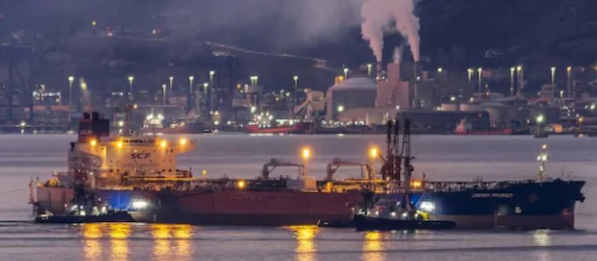
For months, India managed to survive one of the worst global oil shocks in recent years through a narrow opening created by Washington. That window has now shut.
On Sunday, May 17, the Trump administration allowed a sanctions waiver on Russian seaborne crude to expire. The decision may look technical on paper, but for India, it changes the entire energy equation.
The timing could not have been worse.
The Strait of Hormuz — the world’s most critical oil chokepoint — remains under disruption due to the Iran war. Tanker movements have slowed. Insurance costs have jumped. Global crude prices have surged above $105 per barrel from around $72 before the conflict began.
India is now staring at a double squeeze — Middle East oil flows are unstable, and Russian oil now carries sanctions risk again.
The Window That Kept India Afloat
After Russia’s invasion of Ukraine in 2022, Western nations imposed severe sanctions on Russian energy exports. However, India — the world’s third-largest oil importer — continued buying discounted Russian crude thanks to a unique carve-out.
The U.S. granted India a temporary sanctions waiver allowing Russian seaborne crude imports, provided payments were routed through non-sanctioned channels. This narrow opening worked brilliantly for New Delhi.
What the waiver meant for India:
- Discounts of $25–35 per barrel compared to Brent crude
- Savings of over $10 billion in import bills in 2023–24 alone
- Reduced dependence on traditional Middle Eastern suppliers
- Lower inflation and stable fuel prices domestically
Russian oil’s share in India’s import basket jumped from less than 1% (pre-war) to nearly 40% at its peak. This strategic shift insulated India from global price shocks — until now.
Why the Waiver Expired Now
The Trump administration’s decision to let the waiver lapse on May 17 is not arbitrary. U.S. officials have grown frustrated with Russia’s continued war efforts and have tightened secondary sanctions on any entity facilitating Russian energy trade.
Key reasons for the expiry:
- Increased sanctions enforcement targeting shadow tanker fleets
- Pressure from European allies to close loopholes
- Recent evidence of military technology transfers from Russia to Iran
The timing aligns with Washington’s broader strategy to drain Russia’s energy revenues ahead of anticipated peace talks later this year.
A Dangerous Double Squeeze
Now, India faces simultaneous supply and price shocks from two directions.
First Squeeze: Middle East Instability
The Strait of Hormuz — through which 20% of global oil passes — remains highly volatile due to the ongoing Iran war.
Consequences:
- Tanker insurance premiums have tripled since the conflict began
- Transit delays of 10–15 days for vessels
- Some suppliers have rerouted shipments, increasing freight costs
Even traditional partners like Saudi Arabia and Iraq have raised official selling prices for Asian buyers in recent months.
Second Squeeze: Russian Sanctions Risk
Without the waiver, Indian refiners must now consider:
- Payment delays — banks fear secondary sanctions
- Shipment cancellations — many tankers avoid Indian ports
- Higher transaction costs — alternate payment routes (e.g., UAE dirhams) have become expensive
Some Russian crude cargoes scheduled for May–June delivery to Indian ports have already been put on hold by traders.
How This Affects the Common Indian
The energy squeeze is not just a geopolitical headline — it directly impacts every Indian household and business.
Immediate effects likely include:
- Petrol and diesel price hikes — state-run oil marketing companies may break their recent price freeze
- Higher LPG cylinder costs — subsidized domestic gas could become more expensive
- Inflationary pressure — transport, logistics, and manufacturing costs will rise
- Rupee depreciation — higher oil imports worsen the current account deficit
According to initial estimates, a sustained $105+ oil price could push India’s retail inflation up by 60–80 basis points over the next two quarters.
Can India Find Alternatives?
India is not completely helpless. The government and oil companies are exploring every possible avenue.
Short-term measures:
- Increased imports from Saudi Arabia, Iraq, and UAE — though with less bargaining power
- Strategic petroleum reserves — India has about 9.5 days of crude in reserve, which can be tapped
- Diversifying payment mechanisms — exploring rupee-rouble trade through small banks not under U.S. jurisdiction
Long-term strategies:
- Accelerating renewable energy adoption — solar and wind targets have been revised upward
- Boosting domestic exploration — ONGC and OIL have been asked to ramp up production
- Strengthening ties with Guyana and Brazil — emerging non-OPEC suppliers
However, none of these can replace Russian volumes immediately. Refineries designed for Urals crude cannot switch to other grades overnight without significant yield loss.
Geopolitical Fallout: India’s Balancing Act
India has historically walked a fine line between the West and Russia. The waiver expiry tests that diplomatic tightrope.
On one hand, India wants to maintain its strategic partnership with the U.S. — essential for defence, technology, and trade. On the other, it cannot afford runaway energy costs that hurt economic growth and social stability.
What India might do next:
- Diplomatic push for a fresh waiver or extended transition period
- More aggressive rupee-based trade with Russia, bypassing SWIFT
- Quiet purchases through intermediaries in third countries (e.g., Kazakhstan, Armenia)
Experts believe a complete halt to Russian oil imports is unlikely. Instead, volumes may shrink by 30–40%, and India will pay higher effective prices — just not directly to Russia.
A Wake-Up Call for Energy Security
The expiration of the U.S. sanctions waiver marks the end of an era of cheap, hassle-free Russian crude for India. With Hormuz disrupted and global prices above $105 per barrel, India faces its toughest energy test since the 1973 oil crisis.
The coming weeks will be critical. The government may cut excise duties, release strategic reserves, or renegotiate long-term contracts with Gulf nations. But these are stopgap measures.
The real solution lies in reducing India’s structural dependence on imported oil — through renewables, electric mobility, and domestic exploration. Until then, India remains vulnerable to every geopolitical tremor that shakes the world’s energy markets.