

Maruti Suzuki Hits Historic High: Record-Breaking April 2026 Sales Signal Robust Auto Demand
New Delhi: Maruti Suzuki India Limited (MSIL), the country’s largest carmaker, has kicked off the new financial year with a historic bang. In a resounding display of consumer confidence and robust operational execution, the company reported its highest-ever monthly sales in April 2026.
Total dispatches (including domestic and exports) surged to 2,39,646 units, marking a staggering 33.3% year-on-year growth compared to April 2025, when the company sold 1,79,791 units. This performance not only shattered the company’s previous records but also signaled a strong recovery and expansion phase for the Indian automotive industry.
Domestic Market: A Fortress of Strength
The primary driver of this historic volume was the domestic market. Maruti Suzuki dispatched 1,99,592 units to dealers within India, registering a growth of 31.4% over the same month last year. Within this, the core Passenger Vehicle (PV) and Light Commercial Vehicle (LCV) segment hit an all-time high of 1,91,122 units, underscoring the deep penetration of the Maruti brand across urban and rural India.
Passenger Cars: The Resilience of the Hatchback
Contrary to the global trend of declining hatchback sales, Maruti’s traditional stronghold—the passenger car segment (comprising models like the Alto, S-Presso, Baleno, Swift, Dzire, and WagonR)—recorded 96,725 units in April 2026. A notable highlight within this segment was the resurgence of the entry-level “Mini” category (Alto and S-Presso), which sold 16,066 units. This indicates that while the market is premiumizing, first-time buyers in semi-urban and rural belts are still actively entering the market, buoyed by a favorable monsoon forecast and stable financing rates.
Utility Vehicles (UVs): The Growth Engine
While the passenger cars held steady, the real engine of growth remains the Utility Vehicle segment. Models such as the Brezza, Ertiga, Grand Vitara, Fronx, and Jimny collectively contributed 77,892 units to the domestic tally. When combined with exports, Maruti’s SUV portfolio crossed the 55,000-unit milestone for the first time. This success is largely attributed to the “Maruti Suzuki 3.0” strategy, which focuses on aggressive SUV launches and a shift towards higher-margin, feature-rich vehicles.
Exports: The Overseas Leap
Maruti Suzuki has long dominated Indian roads, but April 2026 proved that its global ambitions are bearing fruit. The company exported 40,054 units last month, a phenomenal 43.5% jump from April 2025. This growth is significant as it helps Maruti balance its production capacity and reduce dependency on the volatile Indian monsoon cycle. Shipments to African, Latin American, and ASEAN markets have ramped up, particularly for the Baleno and Fronx models, which have become “global cars” manufactured in India for the world.
The New Heroes: Victoris and e Vitara
A significant portion of April’s success can be attributed to Maruti’s aggressive product offensive, specifically two new launches that have captured the market’s imagination.
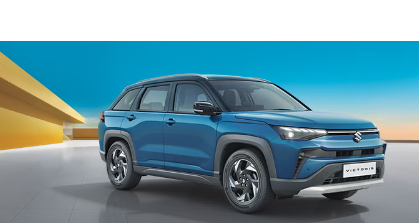
The Maruti Victoris (approx. 13,000 units):
Launched to rival the Hyundai Creta and Kia Seltos, the newly introduced Victoris SUV has had a dream start. Recording roughly 13,000 units in its first full month of sales, the Victoris has successfully filled the premium mid-size SUV gap in Maruti’s lineup. Dealerships across the country report waiting periods of up to four months for the top-end trims, indicating that the initial supply has not yet met the pent-up demand.
The Maruti e Vitara (approx. 2,000+ units):
In a significant milestone for India’s electric vehicle (EV) adoption, Maruti Suzuki’s first born-electric SUV, the e Vitara, crossed 2,000 units in April. While this number is modest compared to petrol volumes, it represents a massive leap for the mass-market EV segment in India. The e Vitara is directly challenging the Tata Nexon EV and MG ZS EV. With Maruti’s trusted service network and a competitive price point, the e Vitara has successfully alleviated “range anxiety” and “brand anxiety” for traditional Indian customers looking to switch to electric mobility.
Market Share and Competitive Landscape
With these blistering numbers, Maruti Suzuki has solidified its dominance, capturing a commanding 38.91% market share in the Indian passenger vehicle segment for April 2026. This is a substantial increase from the 35-36% range the company often hovered around in previous fiscal years.
However, the battle is far from over. Hyundai Motor India and Tata Motors are expected to release their April numbers shortly, with both manufacturers having launched updated products recently. While Maruti leads in volume, the industry will be watching to see if competitors can match the growth rate in the SUV and EV sub-segments.
Supply Chain and Demand Backlog
One of the most critical metrics for any auto manufacturer is the order backlog—an indicator of genuine market demand versus mere wholesale push. Maruti Suzuki ended April 2026 with a healthy order pipeline of roughly 1.65 lakh units.
This backlog provides two key insights:
- Production Constraints: Despite the record month, Maruti is still unable to fully meet demand, particularly for the new Victoris, Fronx Turbo, and the Grand Vitara hybrid.
- Resilient Demand: Even with rising interest rates (compared to the pandemic era lows), the volume of pending orders suggests that the Indian consumer’s appetite for personal mobility remains unsatiated.
Management Commentary
In an official statement, Mr. Shashank Srivastava, Senior Executive Officer (Marketing & Sales) at Maruti Suzuki, attributed the success to a combination of factors: “The strong volume in April can be credited to a robust product lineup that caters to the entry-level as well as the premium customer. The rural sentiment has recovered significantly, contributing to over 40% of our passenger car sales. Furthermore, the operational stability regarding semiconductor supplies has allowed us to run our plants at near-full capacity.”
Regarding the EV space, Mr. Srivastava added, “The response to the e Vitara has exceeded our initial projections. We are seeing customers who never considered an EV before walking into our showrooms because of the Maruti badge. We are confident that this is just the beginning of the green revolution in India.”
Outlook for the Coming Months
While the April numbers are a cause for celebration, the road ahead contains several variables:
- Rural Demand: The onset of the Southwest Monsoon will be critical. A normal monsoon, as predicted by the IMD, will keep rural cash flows high, sustaining the demand for entry-level cars.
- Competition: The mid-size SUV segment is becoming saturated. With the Victoris now in the mix, a price war or increased marketing spend is likely from competitors in May.
- EV Infrastructure: For the e Vitara to maintain its 2,000+ unit run rate, the expansion of fast-charging infrastructure on national highways will be crucial.
Maruti Suzuki’s April 2026 performance is a textbook example of how product strategy, supply chain resilience, and brand trust converge to create a record. By selling nearly 2.4 lakh vehicles in a single month, the company has not only set a high bar for the rest of FY27 but has also reinforced its status as the undisputed bellwether of the Indian automobile industry. As the summer heat peaks, Maruti Suzuki is driving in the fast lane, leaving its past records in the rearview mirror.