

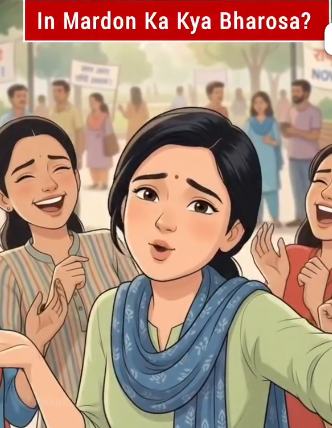
Social media has once again found a quirky phrase that is impossible to ignore. The slogan “Ek Kachori, Do Samosa, In Mardon Ka Kya Bharosa!”, which roughly translates to “One kachori, two samosas, who can trust these men?”, has recently caught the attention of internet users.
What started as a humorous, rhyming slogan has quickly turned into a social media trend, with users sharing reels, memes and posts around the catchy line. The unusual combination of popular Indian snacks and a serious statement about trust has made the phrase particularly memorable among young internet users.
The slogan reportedly gained attention during a recent protest in Delhi where women were raising concerns related to safety and rights. During the demonstration, participants used several creative and rhyming slogans to express their views. Among them, the kachori-samosa line stood out because of its humorous wording and easy-to-remember rhythm.
Soon, clips of the slogan began circulating across social media platforms. Instagram reels, Facebook posts and YouTube videos helped push the phrase beyond the original protest setting and into the wider internet conversation.
Why Is “Ek Kachori, Do Samosa” Going Viral?
The biggest reason behind the popularity of the slogan is its unusual wording.
Indian protests have traditionally featured strong and serious slogans. However, social media has changed the way such moments are consumed and shared. A short, funny and rhyming sentence can sometimes travel much faster than a long political or social message.
“Ek Kachori, Do Samosa” immediately catches attention because kachori and samosa are familiar snacks for millions of Indians. They are everyday foods associated with roadside stalls, tea breaks and local markets.
Putting those words together with “In mardon ka kya bharosa” creates an unexpected contrast.
The line is also extremely easy to repeat. Its rhythm makes it suitable for reels, memes and short videos, which may have contributed to its rapid spread among younger social media users.
From Serious Protest Slogan to Internet Trend
The slogan’s journey is an interesting example of how content can change meaning and context once it enters the social media ecosystem.
At the protest, slogans were being used as a form of public expression. But once videos reached social media, users began focusing on the humorous and catchy aspect of the line.
Memes and reels transformed the slogan into something that could be used in completely different situations.
Some users began treating it as a joke about relationships and dating, while others used it simply because they found the rhyme entertaining. This helped the phrase reach audiences who may not have been following the original protest.
This is common in the age of short-form content. A phrase may begin in one specific social or cultural setting and later become a meme or catchphrase with a much broader internet life.
The Gen-Z Twist
The popularity of the phrase also highlights the way Gen-Z uses language online.
Young internet users frequently take familiar phrases, songs, movie dialogues and traditional sayings and give them a humorous twist. The original expression may remain recognizable, but the new version gets a completely different tone.
In this case, the traditional idea behind “Is sansar ka kya bharosa”—meaning that the world is unpredictable or cannot always be trusted—has effectively been turned into a playful rhyming statement about men.
The use of food items such as kachori and samosa makes the phrase even more relatable.
Instead of sounding like a formal statement, it sounds like something that could naturally become a reel audio, meme caption or joke shared among friends.
Why Rhyming Slogans Work So Well Online
There is another reason why the phrase has found traction: rhythm.
Short rhyming lines are easier to remember than complicated sentences. They can also be repeated collectively, making them effective during public demonstrations.
Social media takes this characteristic even further.
A catchy phrase can be clipped into a few seconds of video, added to music, turned into a meme template or recreated by thousands of users.
Once several creators start using the same phrase, the algorithm can expose it to an even larger audience. The trend then develops a life of its own.
The kachori-samosa slogan fits perfectly into this environment because it is short, humorous and immediately understandable.
From Protest Ground to Instagram Reels
Instagram and YouTube Shorts have played an important role in turning everyday moments into viral trends.
A person watching a short video may not know where a slogan originally came from. They may simply remember the funny line and recreate it.
That appears to be part of what has happened with this phrase.
Clips containing the slogan have been shared and discussed across social media, while users have created their own versions and jokes around it.
Facebook has also helped older and wider audiences encounter the trend, showing how a phrase that begins with younger social media users can quickly cross platforms.
Not Just a Meme, But a Reflection of Internet Culture
Although the phrase is being widely shared for its humour, its origin is connected with a serious conversation around women’s safety and rights.
That contrast is worth noting.
Protests often use slogans because a few powerful words can communicate a larger message. In the social-media era, however, those slogans can also become entertainment content.
The viral journey of “Ek Kachori, Do Samosa” demonstrates how quickly the internet can transform a public expression into a cultural meme.
Different users may interpret the line differently. Some may see it as a humorous dating joke, while others may connect it with the original protest and its broader message.
Why People Can’t Stop Repeating It
Ultimately, the formula is simple: familiar food + rhyme + humour + a relatable statement.
Kachori and samosa are instantly recognizable. The sentence has a natural rhythm. And the final phrase, “kya bharosa,” gives it a punchline-like ending.
That combination makes the slogan easy to remember after hearing it just once.
This is exactly the kind of phrase that social media loves.
Whether the trend remains popular for weeks or eventually disappears like countless other viral memes, the slogan has already demonstrated how quickly an unusual sentence can travel through India’s digital culture.
For now, “Ek Kachori, Do Samosa, In Mardon Ka Kya Bharosa!” has become one of those unexpected internet catchphrases that people are repeating, remixing and turning into memes.
And as social media has repeatedly shown, today’s random viral phrase can become tomorrow’s most recognizable meme.