

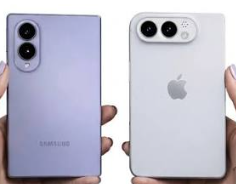
Samsung Galaxy Z Fold 8 vs Apple iPhone 18 Pro is an unusual flagship comparison because the two smartphones take completely different approaches. Samsung’s phone opens into a tablet-like 8-inch display, while Apple’s iPhone 18 Pro sticks with a more traditional 6.3-inch premium smartphone design.
Both sit firmly in the flagship category, but the differences become obvious when you compare their displays, processors, cameras, software, battery and overall design.
The Galaxy Z Fold 8 launched in July 2026, while the iPhone 18 Pro arrived in September 2026. Here’s how the two smartphones compare on paper.
Galaxy Z Fold 8 vs iPhone 18 Pro: Price in India
The iPhone 18 Pro starts at ₹1,64,900 in India, according to current listings. The Galaxy Z Fold 8 is listed at around ₹1,74,999 for its base configuration, although pricing varies by storage and retailer.
| Phone | Starting price in India |
|---|---|
| Samsung Galaxy Z Fold 8 | Around ₹1,74,999 |
| Apple iPhone 18 Pro | ₹1,64,900 |
The Fold 8 therefore sits in a higher price bracket, but it also offers something the iPhone 18 Pro does not: a second, much larger display that unfolds into an 8-inch screen.
Display: 8-Inch Foldable vs 6.3-Inch OLED
This is perhaps the biggest difference between the two phones.
The Galaxy Z Fold 8 features an 8-inch main display with a 4:3 aspect ratio. Samsung has designed it for content consumption, multitasking, gaming and productivity. Its cover screen can be used like a conventional smartphone when the device is folded.
The iPhone 18 Pro, meanwhile, has a 6.3-inch Super Retina XDR OLED display with a 2622 x 1206 resolution, ProMotion adaptive refresh rates up to 120Hz and up to 3,000 nits outdoor peak brightness.
| Display | Galaxy Z Fold 8 | iPhone 18 Pro |
|---|---|---|
| Main screen | 8-inch foldable AMOLED | 6.3-inch OLED |
| Refresh rate | 120Hz | Up to 120Hz |
| Resolution | 1848 × 2448 | 2622 × 1206 |
| Peak brightness | Up to 3,000 nits | Up to 3,000 nits |
| Form factor | Foldable | Conventional |
For watching movies, reading documents or running multiple apps, the Fold 8’s large internal screen is the defining feature.
The iPhone 18 Pro instead offers a more familiar smartphone experience with a high-density display.
Design and Weight
Samsung has made portability a major focus with the Z Fold 8.
The phone weighs 201 grams, making it the lightest Galaxy Z Fold model Samsung has produced. It also uses Samsung’s refined hinge and Flex Titanium display structure.
The iPhone 18 Pro weighs 211 grams and measures 8.75mm thick. Apple uses an aluminium unibody design with Ceramic Shield 2 on the front and Ceramic Shield on the back.
Interestingly, despite being a foldable, the Samsung phone is lighter than the iPhone 18 Pro.
Performance: Snapdragon vs A20 Pro
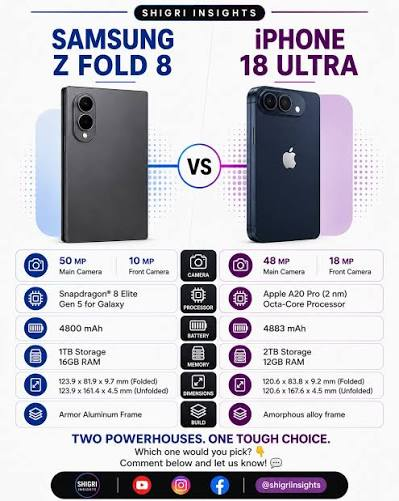
Samsung equips the Galaxy Z Fold 8 with the Snapdragon 8 Elite Gen 5 for Galaxy. The phone is available with 12GB or 16GB RAM, depending on configuration.
The iPhone 18 Pro uses Apple’s A20 Pro chip, built on a 2nm process. Apple lists a six-core CPU, seven-core GPU with Neural Accelerators and a dual 16-core Neural Engine.
| Performance | Galaxy Z Fold 8 | iPhone 18 Pro |
|---|---|---|
| Chip | Snapdragon 8 Elite Gen 5 for Galaxy | Apple A20 Pro |
| Process | 3nm | 2nm |
| RAM | 12GB / 16GB | 12GB listed |
| Software | Android 17 / One UI | iOS 27 |
Raw specifications don’t tell the whole story because Android and iOS manage memory and performance differently. Real-world testing is more useful when comparing sustained performance, gaming and battery efficiency.
Camera Comparison
Samsung has equipped the Galaxy Z Fold 8 with a dual 50MP camera system, according to Samsung’s official information.
Apple takes a different approach with the iPhone 18 Pro.
The iPhone features a 48MP Pro Fusion camera system, including a 48MP main camera with variable aperture, 48MP ultra-wide and 48MP telephoto camera. Apple also supports optical-quality zoom options extending to 8x and digital zoom up to 40x.
The iPhone also offers advanced photography controls, ProRAW, macro photography, spatial photos and extensive video capabilities.
| Camera | Galaxy Z Fold 8 | iPhone 18 Pro |
|---|---|---|
| Main camera | 50MP | 48MP |
| Ultra-wide | Available | 48MP |
| Telephoto | Available | 48MP |
| Video | Flagship-level | Pro video features |
| Special features | Foldable camera experience | ProRAW, variable aperture, advanced video |
Megapixel numbers alone shouldn’t be used to determine image quality. Sensor size, processing, stabilisation and software all play important roles.
Battery and Charging
Samsung has fitted the Galaxy Z Fold 8 with a 4,800mAh battery. The company has increased battery capacity while simultaneously reducing the phone’s weight.
Apple does not normally advertise iPhone battery capacity as a headline specification. The iPhone 18 Pro instead focuses on Apple’s hardware-software optimisation, with MagSafe and Qi2 wireless charging support of up to 25W.
This makes direct battery-capacity comparisons difficult.
Software and Updates
The Galaxy Z Fold 8 runs Android 17 with Samsung One UI and is listed with seven years of OS and security updates.
The iPhone 18 Pro runs iOS 27 and integrates Apple’s latest Apple Intelligence and Siri AI features.
The two software experiences are also fundamentally different.
Samsung’s foldable software is designed around multitasking and the large inner display, while Apple’s interface is optimised around the traditional iPhone form factor and its wider ecosystem of Apple devices and services.
Galaxy Z Fold 8 vs iPhone 18 Pro: Specifications
| Specification | Samsung Galaxy Z Fold 8 | Apple iPhone 18 Pro |
|---|---|---|
| Launch | July 2026 | September 2026 |
| Display | 8-inch foldable | 6.3-inch OLED |
| Refresh rate | 120Hz | Up to 120Hz |
| Processor | Snapdragon 8 Elite Gen 5 | A20 Pro |
| RAM | 12GB / 16GB | 12GB |
| Main camera | 50MP | 48MP |
| Battery | 4,800mAh | Not officially marketed by capacity |
| OS | Android 17 / One UI | iOS 27 |
| Weight | 201g | 211g |
| Storage | Up to 1TB | Up to 2TB |
| Connectivity | 5G | 5G |
| Starting India price | Around ₹1,74,999 | ₹1,64,900 |
Which Phone Has the More Interesting Design?
The Galaxy Z Fold 8 is clearly built around its foldable form factor.
You can use it as a regular phone through the cover screen and then unfold it into a large 8-inch workspace. Samsung specifically positions the larger screen for movies, reading, gaming and multitasking.
The iPhone 18 Pro is more conventional, but that can also be an advantage for users who simply want a traditional flagship smartphone without a hinge or foldable display.
Galaxy Z Fold 8 vs iPhone 18 Pro: The Big Difference
The biggest distinction isn’t actually the processor or camera.
It’s how you use the phone.
The Galaxy Z Fold 8 is designed for people who want a smartphone that can transform into a larger-screen device. Its 8-inch display creates possibilities for multitasking, documents, gaming and media that a conventional 6.3-inch phone cannot replicate.
The iPhone 18 Pro is built around Apple’s traditional flagship formula: a compact premium design, A20 Pro performance, advanced cameras, iOS 27 and deep integration with Apple’s ecosystem.
Final Take
The Samsung Galaxy Z Fold 8 and iPhone 18 Pro represent two very different definitions of a premium smartphone.
Samsung’s biggest headline is its 8-inch foldable display and multitasking-focused design, while Apple’s standout features include the A20 Pro chip, 48MP Pro Fusion camera system, 120Hz OLED display and iOS ecosystem.
The price difference is also relatively significant, with current Indian listings placing the Fold 8 above the iPhone 18 Pro.
For a buyer comparing these two phones, the key question is less about a simple specification number and more about whether they want a large foldable workspace or a conventional flagship iPhone experience.