

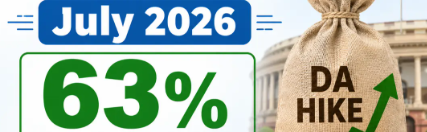
DA Hike July 2026: Central government employees and pensioners are waiting for the next revision in Dearness Allowance (DA) and Dearness Relief (DR). The latest Consumer Price Index for Industrial Workers (CPI-IW) data has now completed the calculation cycle for the July 2026 revision, and the numbers indicate a 3 percentage point increase.
If approved, the DA rate for central government employees could rise from the existing 60% to 63% of basic pay under the 7th Central Pay Commission framework. Pensioners would similarly see Dearness Relief increase to 63% of basic pension.
The calculation is based on CPI-IW data released by the Labour Bureau. However, employees should note that the calculated figure and the final government-approved DA rate are not the same thing. The revised rate becomes official only after the government approves and notifies it.
DA Could Increase From 60% to 63%
The current DA rate for central government employees is 60% of basic pay following the January 2026 revision. The Union Cabinet had approved a 2% increase effective January 1, 2026, taking DA from 58% to 60%. The same revision increased Dearness Relief for pensioners to 60%.
For the July 2026 revision, the CPI-IW numbers point towards another 3% increase.
That would take the DA calculation to approximately 63.75%, with the decimal portion ignored under the prevailing calculation approach, resulting in a payable rate of 63%, subject to formal approval.
This means the headline figure employees are currently watching is:
60% → 63%
The increase would be effective from July 1, 2026, once officially approved.
June CPI-IW Data Completes the Calculation
The most important development for the July 2026 DA revision was the release of the June 2026 CPI-IW figure.
According to the Labour Bureau, the All-India CPI-IW for June 2026 stood at 151.9, compared with 150.8 in May. The Labour Bureau explains that CPI-IW measures changes in retail prices of a fixed basket of goods and services consumed by industrial workers. These indices are also used for regulating wages and Dearness Allowance.
June is particularly important because the six monthly CPI-IW figures from January through June are used for calculating the DA revision applicable from July.
With June’s figure now available, the data required for the July 2026 calculation has been completed.
How Much Will Salary Increase?
A 3 percentage point increase does not mean every employee will receive ₹3,000 or ₹3,000 extra. The actual increase depends on the employee’s basic pay.
For example, if an employee has a basic salary of ₹18,000, the difference between 60% and 63% DA would be:
- Existing DA at 60%: ₹10,800
- DA at 63%: ₹11,340
- Increase: ₹540 per month
For a basic pay of ₹25,500:
- 60% DA: ₹15,300
- 63% DA: ₹16,065
- Increase: ₹765 per month
For a basic pay of ₹40,000:
- 60% DA: ₹24,000
- 63% DA: ₹25,200
- Increase: ₹1,200 per month
These are simple calculations based only on the DA component. The overall change in take-home salary can differ because other salary components and deductions may also apply.
What About Central Government Pensioners?
The same revision is relevant to central government pensioners through Dearness Relief (DR).
If the rate rises from 60% to 63%, pensioners would receive an additional 3% of their basic pension as DR.
For example, a pensioner with a basic pension of ₹20,000 would see the DR component change from:
60% = ₹12,000
to
63% = ₹12,600
The difference would therefore be ₹600 per month, before considering other pension components or deductions.
Why CPI-IW Matters for DA
The CPI-IW is not simply a general inflation number used casually for calculating DA. The Labour Bureau states that the index is specifically used for regulation of wages and Dearness Allowance for millions of workers and employees.
The current CPI-IW series uses 2016 as its base year, and the index is compiled every month. The All-India index is calculated using data from selected centres across India.
Under the 7th Central Pay Commission’s accepted formula, these inflation figures form the basis for determining the DA revision.
That is why employees closely follow every monthly CPI-IW release, particularly during the six-month period leading up to January and July DA revisions.
July 2026 DA: When Will Employees Get the Benefit?
The revised DA is applicable from July 1, 2026, but the actual payment depends on when the government formally approves and notifies the increase.
In previous DA revisions, the Cabinet has approved the additional instalment after the relevant CPI-IW calculation period has ended.
For example, in April 2026, the Union Cabinet approved the 2% DA/DR increase applicable from January 1, 2026, taking the rate from 58% to 60%. The government said the increase followed the accepted formula based on the recommendations of the 7th Central Pay Commission.
Therefore, the July 2026 figure should currently be described as 63% based on the completed calculation, rather than claiming that the Cabinet has already approved the rate unless an official notification confirms it.
What Happens to Arrears?
Because the July revision is effective from July 1, 2026, employees could become eligible for arrears for the period between the effective date and the month in which the revised DA is actually paid, if the government approves the increase retrospectively from July 1.
The exact payment mechanism and arrears amount will depend on the government’s official order.
Employees should therefore wait for the Department of Expenditure/Ministry of Finance notification for the final details.
8th Pay Commission and July DA
The July 2026 DA revision is taking place while preparations for the 8th Central Pay Commission are also underway.
The two developments should not be confused.
The July DA revision relates to the existing 7th Pay Commission salary structure. The 8th Pay Commission, once implemented, would involve a new pay structure based on the recommendations accepted by the government.
Therefore, a 63% DA rate under the 7th CPC does not itself represent the final salary structure under the 8th Pay Commission.
Employees will need to wait for the 8th Pay Commission’s recommendations and subsequent government decisions regarding implementation, fitment and revised pay.
DA Hike July 2026: Key Points
| Particular | July 2026 DA Revision |
|---|---|
| Existing DA | 60% |
| Expected increase | 3 percentage points |
| Calculated rate | Around 63.75% |
| Payable rate indicated by calculation | 63% |
| Effective date | July 1, 2026 |
| Basis | CPI-IW data |
| June 2026 CPI-IW | 151.9 |
| Employees covered | Central government employees |
| Pensioners covered | Central government pensioners through DR |
| Pay Commission framework | 7th CPC |
Final Word
The July 2026 DA revision is now much clearer after the release of the June CPI-IW data. The calculation points towards a 3 percentage point increase, which would take the Dearness Allowance from 60% to 63% of basic pay.
The Labour Bureau’s June CPI-IW figure of 151.9 completed the data required for the July calculation.
For employees and pensioners, the important point is that 63% is currently the calculated outcome, while the final payable rate depends on formal government approval and notification.
If approved from July 1, the increase would raise the DA/DR rate by 3 percentage points and could also result in arrears for the applicable period. Meanwhile, the separate 8th Pay Commission process remains an important development for the future salary structure.
Employees should therefore watch for the official government order before treating the 63% figure as formally notified.