

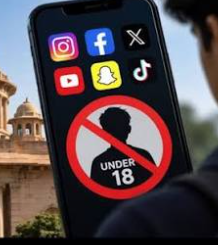
New Delhi: Social media usage by children and teenagers could face tighter regulation in India after the Supreme Court asked the Centre to consider a statutory framework requiring digital platforms to comply with Indian laws governing minors.
A three-judge bench headed by Chief Justice of India Surya Kant, along with Justices Joymalya Bagchi and V. Mohana, raised the issue while hearing a public interest litigation concerning safeguards for children using social media and other digital platforms.
The court specifically asked the government to examine whether existing intermediary rules could be used to require platforms to configure their systems in accordance with Indian law, including the legal position concerning minors below the age of 18.
Supreme Court focuses on 18-year age threshold
One of the central issues before the court is the ability of minors to independently enter into agreements with social-media platforms.
When a person creates an account, they generally agree to terms of service, privacy policies and other contractual conditions. The petition argues that this creates a legal question because Indian law does not generally recognise minors as having the same contractual capacity as adults.
During the hearing, Justice Joymalya Bagchi emphasised that platforms should at least ensure that their membership systems comply with the 18-year threshold under Indian law.
The court’s intervention does not, however, mean that an immediate nationwide 18+ social-media ban has already come into force.
Instead, the Centre has been asked to examine the issue and consider putting enforceable statutory safeguards in place.
Why did the Supreme Court raise this issue?
The case was brought by Just Rights for Children Alliance, which has sought stronger safeguards for minors using social media and digital platforms.
The petition raises concerns about children independently creating accounts despite their age and the absence of a uniform, enforceable age-assurance mechanism.
It highlights several risks associated with children’s online exposure, including online grooming, sexual exploitation, trafficking, cyberbullying, behavioural profiling, misuse of personal information and exposure to age-inappropriate material.
The petition argues that these concerns require more than voluntary policies adopted by individual technology companies.
What did the Centre tell the Supreme Court?
Solicitor General Tushar Mehta, representing the Centre, indicated that the government would examine the matter and take appropriate steps.
The Centre also discussed whether existing legal provisions could provide a basis for regulating intermediaries.
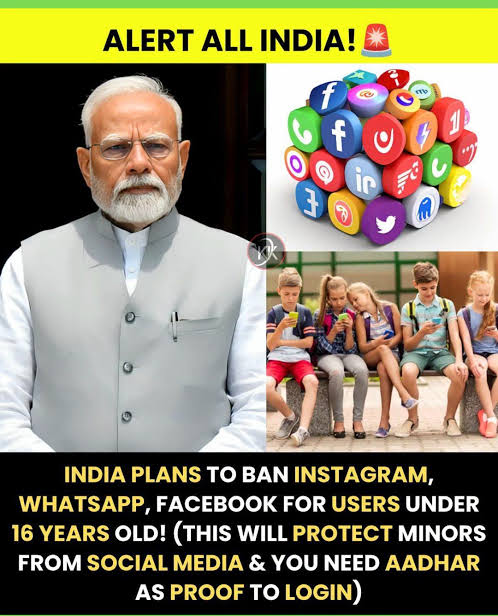
Reports from the hearing indicate that the government is considering changes or statutory measures under the existing intermediary framework. One proposal discussed was making age restrictions an enforceable obligation for platforms rather than simply issuing non-binding guidance.
The government has also referred to the Digital Personal Data Protection Act, 2023, which contains specific provisions concerning children’s personal data and parental consent. However, the petitioner’s side argued that the relevant data-protection framework does not immediately resolve the broader question of minors independently entering into platform agreements.
Does this mean Instagram, Facebook and other platforms will become 18+ immediately?
No.
This distinction is important.
The Supreme Court has not announced an immediate blanket ban making all social-media platforms 18+ in India.
The court has asked the Centre to work on a statutory mechanism that would ensure digital intermediaries operate consistently with Indian law.
The government must still determine the precise legal and technical framework, including how age verification would work and what exceptions, if any, would apply.
Therefore, users should not interpret the latest hearing as an immediate shutdown of accounts belonging to everyone under 18.
How could the new rules work?
If the government ultimately introduces enforceable rules, platforms could potentially be required to introduce stronger age-assurance mechanisms.
These could involve:
- More reliable age verification during account creation
- Restrictions on independent accounts for users below 18
- Parental or guardian consent mechanisms where legally permitted
- Stronger identity verification
- Additional safeguards for children’s personal data
- Platform-level systems designed to prevent circumvention of age restrictions
- Greater accountability for intermediaries that fail to comply
The exact mechanism has not yet been finalised.
This is likely to be one of the most difficult aspects of implementing any nationwide age restriction because platforms need to establish a user’s age without creating unnecessary privacy and data-security risks.
What about the current age rules of social-media platforms?
Many international social-media services have historically permitted users to create accounts from around the age of 13, subject to their individual terms and applicable laws.
The Supreme Court proceedings have brought the difference between such platform policies and India’s legal framework into focus.
The petition specifically pointed to platforms that permit younger users to independently create accounts and argued that this approach needs to be reconciled with Indian law concerning minors.
The court’s position is that digital platforms operating in India cannot simply rely on their own contractual policies if those policies conflict with applicable Indian legal requirements.
What could change for parents and children?
If statutory rules are eventually introduced, parents could see significant changes in how children’s accounts are created and managed.
Platforms could require parents or legal guardians to provide consent before certain services are accessed.
There could also be greater restrictions on the collection and processing of children’s personal information.
For teenagers who currently maintain social-media accounts independently, an enforceable 18-year membership threshold could mean that platforms have to introduce new verification systems or restrict access until the user reaches the legally prescribed age.
However, the final rules will determine exactly how this works.
Why age verification could become the biggest challenge
Simply asking users to enter their date of birth is relatively easy, but it does not necessarily prove that the information supplied is accurate.
A stronger system would need to establish age while balancing privacy and security.
If platforms require government-issued identity documents from every user, that could create concerns around the collection and storage of sensitive personal information.
On the other hand, a system based entirely on self-declaration could be difficult to enforce.
The government will therefore have to consider both child safety and privacy while designing the framework.
Supreme Court’s message to digital platforms
The proceedings send a clear legal message that the operation of digital platforms in India is subject to Indian law.
The court asked the Centre to consider directions under the Information Technology intermediary rules so that platforms configure their systems in conformity with Indian legal requirements.
The Supreme Court has also previously dealt with the responsibilities of intermediaries concerning child sexual exploitation material. In its September 2024 judgment, the court held that intermediary due diligence includes compliance with mandatory reporting requirements under the POCSO framework in relevant cases.
What happens next?
The Centre will now examine the legal and regulatory options available for addressing minors’ access to social media.
The key questions will include how an 18-year threshold can be implemented, what form parental consent could take, how age verification can be conducted and how children’s privacy can be protected.
For now, there is no immediate blanket 18+ social-media ban in force solely because of this Supreme Court hearing.
The important development is that the court has pushed the Centre toward an enforceable statutory solution rather than leaving the issue entirely to voluntary platform policies.
If new rules are ultimately notified, they could fundamentally change how social-media accounts are created and operated by minors in India.
The Supreme Court has asked the Centre to examine statutory safeguards requiring social-media platforms and other digital intermediaries to comply with Indian laws concerning minors, with the 18-year threshold emerging as a key issue.
The government has indicated that it will examine the matter. The final rules, however, have not yet been implemented, so users should wait for an official notification before assuming that all under-18 social-media accounts will immediately be blocked.