

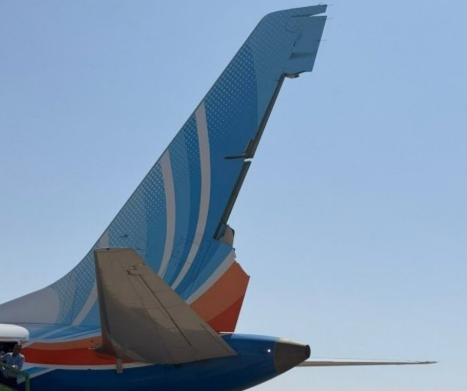
New images from Tabuk, Saudi Arabia, have revealed significant damage to the tail section of Flydubai Flight FZ1073, giving a clearer picture of the extraordinary aerodynamic forces the aircraft may have experienced during its terrifying emergency descent.
The Boeing 737 MAX was flying from Dubai to Tel Aviv on September 30 when a serious incident unfolded inside the cockpit. The aircraft subsequently made an emergency landing at Prince Sultan bin Abdulaziz International Airport in Tabuk, Saudi Arabia.
According to Saudi authorities, the aircraft landed safely with 174 passengers and eight crew members aboard. A preliminary Saudi investigation found that the first officer had assaulted the captain, leaving both pilots injured.
But the dramatic flight also involved an extremely rapid change in altitude. Flight-tracking data showed the aircraft falling more than 14,000 feet in less than half a minute at one stage, before recovering and eventually diverting to Tabuk.
What happened to Flydubai Flight FZ1073?
Flydubai confirmed that FZ1073, operating from Dubai International Airport to Ben Gurion International Airport, experienced an incident while en route. The airline initially said the aircraft landed safely in Tabuk and that all passengers were safe and accounted for.
Flight-tracking information subsequently showed an extraordinary flight profile.
The aircraft had been cruising at around 34,000 feet before beginning a very steep descent. Flightradar24 reported that the aircraft transmitted the general emergency code 7700, followed by 7500, which is associated with unlawful interference, before later returning to 7700.
Reports indicate that passengers and crew members eventually managed to intervene in the cockpit incident. A reserve crew member then helped take control of the aircraft, allowing it to divert safely to Tabuk.
Why was the descent so dangerous?
Commercial aircraft are designed to withstand substantial aerodynamic loads, including turbulence, high-speed flight and emergency manoeuvres. However, an uncontrolled or extremely rapid descent can place unusual stresses on the airframe.
During normal cruise flight, an aircraft maintains a carefully controlled relationship between altitude, airspeed, engine thrust and aerodynamic forces.
During a steep descent, gravity accelerates the aircraft downward. If the aircraft also develops significant forward speed, the resulting airflow over the wings, fuselage and tail can become considerably stronger.
This becomes particularly important around the aircraft’s flight-control surfaces.
The vertical stabilizer and rudder at the rear of the aircraft help maintain directional stability and allow pilots to control yaw. They are exposed directly to airflow and therefore experience aerodynamic loads whenever the aircraft is flying.
Images show damage to the tail
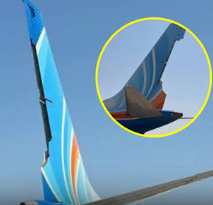
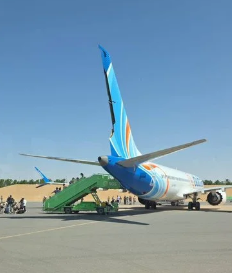
Photographs taken after the aircraft landed in Tabuk appear to show a section of the rudder missing from the aircraft’s vertical tail assembly. Reports have described the damage as significant, with part of the movable rudder apparently separated from the tail.
The visual evidence has naturally raised an important question: could the extreme descent have caused the damage?
At this stage, that remains a possibility rather than a confirmed finding.
Aviation reports have suggested that the aircraft may have experienced unusually high aerodynamic loads during the rapid descent and subsequent manoeuvres. However, investigators will need to inspect the aircraft, examine the damaged components and analyse flight-data and maintenance information before determining exactly what happened.
Therefore, it would be premature to state that the emergency descent definitively caused the tail damage.
What happens to an aircraft during an extreme descent?
An aircraft descending rapidly does not simply fall vertically like an object dropped from the sky.
Its wings and control surfaces continue interacting with the atmosphere. As airspeed changes, aerodynamic forces change as well.
The tail is particularly important because it provides stability and control. The horizontal stabilizer controls pitch, while the vertical stabilizer and rudder contribute to directional stability and yaw control.
If an aircraft experiences excessive speed, abrupt changes in attitude or aggressive control inputs, components can potentially be exposed to loads well beyond those encountered during routine flight.
That is why aircraft manufacturers establish strict operating limitations, including maximum speeds and structural limits.
Did the aircraft lose control completely?
Available information suggests the aircraft went through a highly unstable period, but it ultimately recovered sufficiently to continue flying and land safely.
Another analysis of the flight described a plunge from approximately 34,000 feet to around 17,000 feet in a matter of seconds.
The aircraft subsequently continued toward Tabuk, where it was safely landed.
This is significant because the aircraft’s survival demonstrates that even after experiencing an extraordinary emergency, the airframe retained sufficient controllability for the replacement crew to bring it to the airport.
What about the missing panels near the APU?
Some descriptions of the photographs have referred to missing material around the rear section of the aircraft and near the auxiliary power unit, or APU, area.
However, the exact nature and location of every damaged or missing panel has not yet been officially established in the sources available so far.
The APU is a small turbine engine located in the rear fuselage of many commercial aircraft. It is primarily used to provide electrical power and pneumatic power when the main engines are not supplying those functions.
Because the APU is located near the tail, damage in the rear fuselage can understandably raise questions about whether the APU area was affected.
But the presence of missing panels or visible damage does not by itself prove that the APU caused, suffered or contributed to the incident.
Investigation will determine the real cause
Saudi Arabia’s National Transport Safety Center has opened a safety investigation into the emergency landing. Investigators are coordinating with relevant authorities to establish the circumstances, examine aviation-safety aspects and collect evidence.
The aircraft itself will be an important source of evidence.
Investigators can examine:
- Flight-control surfaces
- Rudder and vertical stabilizer components
- Fuselage panels
- Evidence of overstress or structural failure
- Flight-data recorder information
- Cockpit voice recordings
- Aircraft maintenance records
- Engine and flight-control systems
- The sequence of altitude and airspeed changes
The physical damage can also help investigators reconstruct what happened during the most extreme portions of the flight.
Passengers eventually continued their journey
Despite the extraordinary events, the aircraft landed safely in Tabuk.
Saudi authorities said all passengers and crew members received necessary assistance. The passengers later continued their journey on a replacement Flydubai aircraft, while the injured pilots received medical treatment.
Flydubai has also confirmed that it is cooperating with relevant authorities and that further updates will be issued as confirmed information becomes available.
Why the tail damage matters
The newly visible tail damage is important because it provides investigators with physical evidence of the stresses experienced by the aircraft.
However, photographs alone cannot establish whether the damage occurred during the initial rapid descent, during subsequent manoeuvres, because of excessive airspeed, or from another event.
The investigation will therefore be critical.
For now, the confirmed picture is that Flydubai FZ1073 experienced a serious cockpit incident, underwent an exceptionally rapid and unusual descent, diverted to Tabuk and landed safely. Images afterward showed substantial damage around the aircraft’s tail, including an apparent missing section of the rudder. The precise mechanism that caused that damage remains under investigation.
As investigators release more information from the aircraft’s flight-data recorders and physical inspection, a clearer explanation should emerge about exactly how the Boeing 737 MAX survived the extreme sequence of events and what caused the visible tail damage.